Rocky Mountain Quilt Museum

The Rocky Mountain Quilt Museum is a small museum in downtown Golden, Colorado which housed around 15 – 20 quilts when we visited there a few days ago.  All the quilts were from the 1800s and were from a collection of ONE person.  So, let’s take a peek at what I got to see.

The entrance looks quaint, doesn’t it?


Just a few of the quilts along with a close up of the quilting…

This one was my daughter’s favorite of the bunch.


This one looks like it should be Native American.  I think the stripes in the strips/logs is what makes it look like a Native American quilt to me.

The strips/logs were about 1/4″ to 1/2″ inch wide.  Lots of work there!

Do you know what this design is called?

All quilting was hand stitched.

WARNING for fabric addicts…

A recent study indicated that fabric gives off certain Pheromones that actually hypnotize women and cause them to purchase unreasonable amounts.  When stored in large quantities in enclosed spaces, the Pheromones (in the fabric) causes memory loss and induces the nesting syndrome (similar to the one squirrels have before the onset of winter i.e., storing food).  Therefore perpetuating their species and not having a population loss due to their kind being cut into pieces and mixed with others.

Sound tests have also revealed that these fabrics emit a very high pitched sound, heard only by a select few, a breed of women know as “quilters.”  When played backwards on an LP, the sounds are heard as chants, “buy me, cut me and sew me.”  In order to overcome the so called “feeding frenzy effect” that these fabrics cause, one must wear a face mask when entering a storage facility and use ear plugs to avoid being pulled into their grip.  One must laugh, however, at the sight of customers in a quilt fabric store, with WWII army gas masks and headphones!

Studies have also indicated that aliens have inhabited the earth, helping to spread the effects that these fabrics have on the human population.  They are called QUILT FABRIC STORE CLERKS.  It’s also been experienced that these same Pheromones cause a pathological need to hide these fabric purchases when taken home (or at least blend them into the existing stash), and when asked by significant other if the fabric is new, the reply is “I’ve had it for awhile.”

~ Kathy Smith Harris, 1997

Charity Quilts

One of the things I am doing when I don’t have customer quilts to work on is quilting charity quilts.   This particular quilt was perfect for using a pantograph because it had no borders and no regimented block placement.  I don’t normally like using pantos (pantographs), because it’s not as easy for me to follow a line from a paper and then hope it turns out okay on the quilt itself as it is for me to be able to watch where my next quilting stitch will go (whether it is free hand or drawn on there with a disappearing marker).  At least if I’m watching where I will be going next, I can quickly fix a mistake.  Pantos aren’t as easy as they are cracked up to be, BUT they are great practice for mastering your machine and the pantograph itself.  You will be building muscle memory for when you want to do those swirls and curls and feathers, etc. either on your own or with another pantograph.

I enjoyed this particular design once I got started.

These 2 quilts were very similar, and I was given enough backing for both of them to load as one piece (well, it was pieced but was loaded as one piece), so I put the backing on the frame and then loaded my first quilt, quilted it, and then loaded the 2nd quilt and quilted it with the 1st one already done and rolled up on the frame ahead of it.

This one was harder for me to follow.  I don’t know if it was because the patterns are so “definite” so a mess-up would be more noticeable or what…  Perhaps it is because there is a lot of open space?  Or???

The other thing that was happening while I was quilting this particular pattern was my machine was getting hung up on something.  I never did find out what it was getting caught on.  I would stop each time and check all over, around, and under but with no luck of finding what it was… a loose thread, bumpy seam, cord, etc.  Thank goodness I wasn’t getting paid to do this!

What’s REALLY in that Haggis anyway?

Image

Since I have been listening to The Outlander Series by Diana Gabaldon on CDs while I am quilting, it seems only fitting that I attend a Scottish Festival of sorts.  I am up to the 4th book in the series, “Drums of Autumn” and loving every minute of her books.  Jamie Fraser was in the Battle of Culloden in one of the books, and I heard a bit about Culloden today.  It sounds like Culloden really was the turning point in Highland history as far as when the Scots were “ethnically cleansed” by the English.  They were made to swear loyalty to England, give up their kilts and way of dress, were forbidden to speak Gaelic, etc.  Kind of makes me sad, so it was an honor today to get to see some of the Scottish culture and heritage that was taken from them.

We saw lots of men in kilts at the Scottish Highland Games & Celtic Festival today.  Actually, there were women in kilts as well and lots of plaid!  When asked what they wore under their kilts, one answer was shoes and socks.

The first group we ran up on were a few bagpipers…

Image

This next picture of me is on our way to the Heritage & Culture tent where we were greeted by many “clans” of ticks.  Truly!  We were listening to a man talk about the history of kilts, how they are folded and worn, etc. and we must have had 10 or more ticks jump on us.  They were jumping, and not in a good way!

Image

The bagpipe & drums band was really good.

Image

They looked so regal marching past us.

Image

My husband’s clan is Clan Donald or Clan McDonald, depending on which day it is.  ;o)  When the Clans marched past, his clan had 5 representatives.

Image

They also had the biggest tent along Clan Row.  The Donalds and McDonalds, along with the McDonnell’s are in an area (Isle of Skye) near where Clan Stewart lived in the times before the Battle of Culloden.  The McDonalds and other clans fought for Charles Stewart, protecting Scotland for Charles to be their future king.  It didn’t work.  The Scots were slaughtered and made to deny their heritage and claim loyalty to the English.  From what I understand, the clan of my father is the Sutherland Clan.  You’d think Sutherland would stand for southern land, but no.  They are in the northern area.  Go figure!

The highlight and most memorable part of the day was when we decided to get something to eat.  Haggis is well known as a Scottish food.  Have any of you tried it?  We never have, so I told my husband that if he would try it, I would.  He said he didn’t like it.  He’s never tried it, though, so my question for him was how he knew he didn’t like it if he had never even tried it.  So, there we were, standing in line…

Image

The menu said it had sheep heart and liver in it, but doesn’t it look like a mixture of hamburger and CAKE?

Image

Then we tried it.  First my husband, and then me.

Image

Oh God!  Oh.  God.  Words can’t describe the taste – it’s just a weird taste that needs time in order to be an acquired taste.

My husband’s eye looks like it’s going to tear after trying it. I wanted to rub my tongue on asphalt after trying it!  All I know is that I wanted a big pickle and some beer (and I’m not a beer drinker) afterwards to bury the taste. My mouth still draws up just thinking about it.  You’ve seen those videos of babies being fed something they don’t like, haven’t you?  That’s the look.  When someone dares you to try it, you can stomach it, but make sure you have something to kill the taste afterwards, and not just a can of pop!  That didn’t work for me!

Anyhow, I’m glad I got the opportunity for today’s cultural experience, and I’m glad that I got to try Haggis.  We are all different, and you have to appreciate someone having the courage to eat haggis on a regular basis.

Blocking… the final frontier

The quilting is done and all I need to do now is add the binding before sending this quilt back to its owner.  But, before I do the binding, I want to “block” it to make sure it will lay flat and square.  I’ve heard that once you block a quilt, it will always be square, but I don’t know about that.  Have any of you heard that?

So, here goes the blocking and how I do it.  There are many strategies for blocking, but I’ve found that using a laser square is the easiest for me.  First I lay out the quilt onto a surface that I can pin into – that would be my design wall placed on the floor.  I forgot to tell you that I get the quilt wet first and run it through the spin cycle in the washing machine and then air fluff it so that it’s not soaking wet; just damp enough to nudge the fibers around.

I start at opposite corners and try to make sure those corners are fairly square and then do the other 2 opposite corners.  This is just to get them in the ball park area, because you are going to be doing some nudging and things will shift.  I then work from the middle out – I start with the middle blocks and make sure they are as square as possible, putting a few pins in there to hold the blocks in place while I work outward.

Image

You can barely see the orange beam of light along the blocks’ edges, but you can see where the laser square is on the right side of the picture.  Look for a horizontal beam and a vertical beam.

Sometimes as I am working along a seam line, the beam gets blocked by a pin or the quilt sticking up a bit in an area.  In that case I run my finger along the beam to help me nudge the fabric into line.

Image

When I’ve got the blocks where I want them, I then start with the inner borders and make sure they are square, sticking more pins along the lines to hold them in place.

Image

And then I move to the inside edge of the outer border.  Yes, more pins!

Image

And then, finally, the outside perimeter of the quilt… I stick the most pins along these edges and will many times I will go back and remove some of the pins that are inside, especially those around the blocks and sashing.  The quilt is where I want it at this point, and it will just be laying there.

Image

When I’ve got it all pinned in place, I finger press down the edges to get it completely flat and then let it dry for a couple of days.  This is a good reason to have a place that will be undisturbed.  Oh, and I have a fan or 2 blowing air on it to help it dry.  Then, it will be ready for binding.

So, if you have a laser square tucked away somewhere in your garage or in your husband’s tools, borrow it some time to see if this strategy is easier for you, too!

Frogging…

So, it’s been a couple of weeks since I’ve posted about my quilting progress.  I’ve barely had time to work on the latest due to being at Machine Quilters Showcase the week of My 12-19th.  Last week I had doctors’ appointments and husband appointments to deal with.  So, here I am ready to finish this quilt and get it back to the owner.  Yesterday I finished all the quilting on it, so all I should have to do now is block it and sew the binding on it and get it back to the customer within the next few days.  I say “should” because as I was stitching on it, a nagging thought crept up in the back of my mind telling me that my stitching was WRONG, that it needed to be fixed, which leads to frogging…

If you don’t know what frogging is, it’s an eeeeevil, naaaaasty, dirty word in the quilting world.  The term derives from a frog croaking “Rip it!  Rip it!” meaning to rip out imperfect stitches.  In my mind, my quilting on customers’ quilts should be to enhance the piecing or applique, not to over power it with my stitching.  However, if it is a show quilt, then by all means, there should be lots of embellished quilting and as some people say, “it should be quilted to death!”

So, there I was quilting along and I got to the corners of the outside border.  Now the quilt itself has blocks in the middle with orange sashing separating the blocks.  It also has an inner, pieced border outlined with solid black thin borders framing the inner border.  The outside border, however, is plain white/cream.  My quilting in the blocks is done with cream colored thread, so as to show off the blocks.  The quilting in the sashing is done with an orange, variegated thread that will enhance the sashing just a bit.  But, that outside border just needed something.  I didn’t feel right quilting it with the same color thread as the fabric itself, so I am basically “drawing” with black thread on it.  I don’t yet feel confident enough with my drawing abilities to make my quilting stand out that much, but I doubt I ever will.  I’m plunging in and doing it anyway.  People keep telling me that I’m better at quilting than I think I am, so I am trying to listen to that and plunge away.

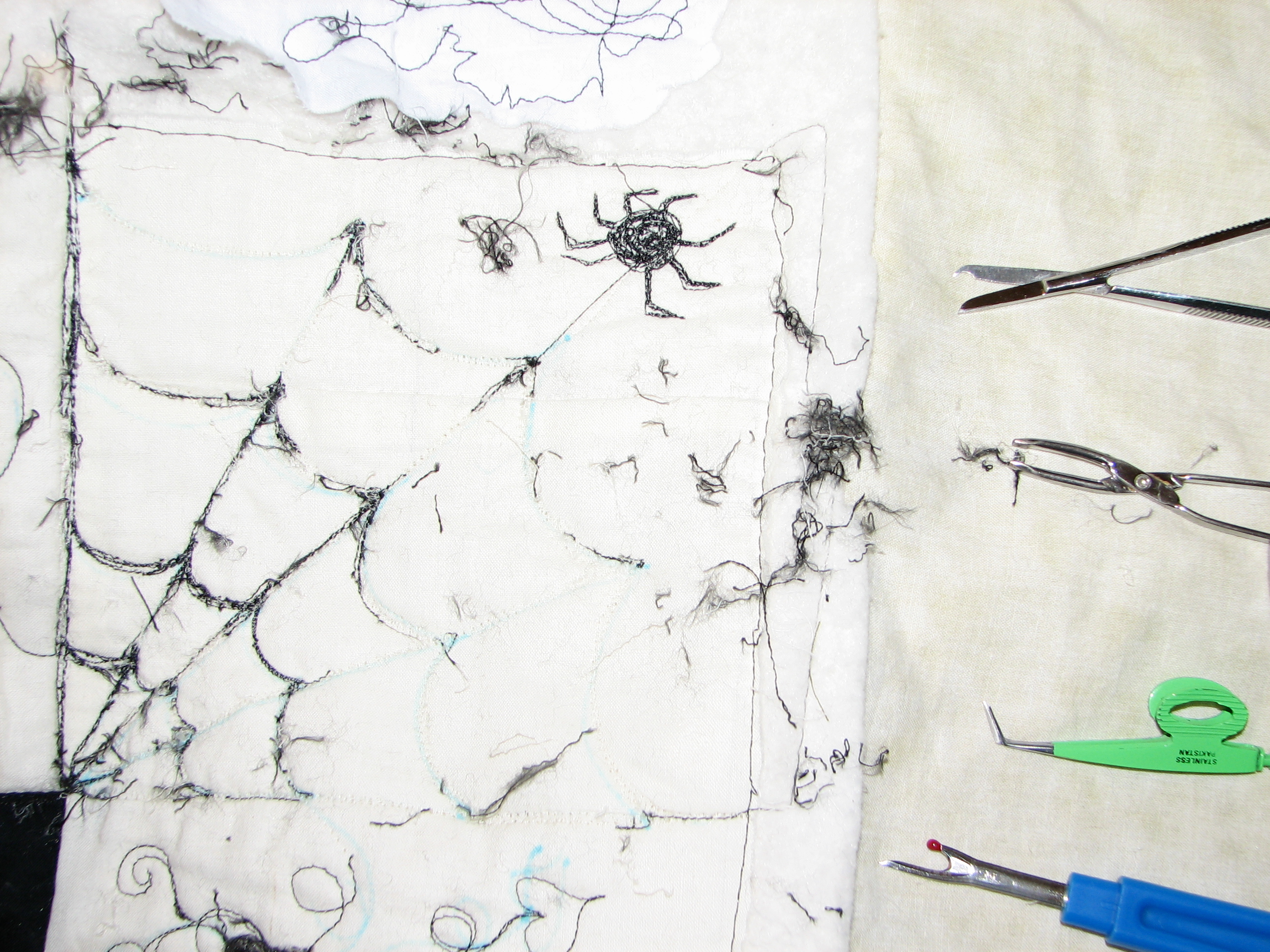
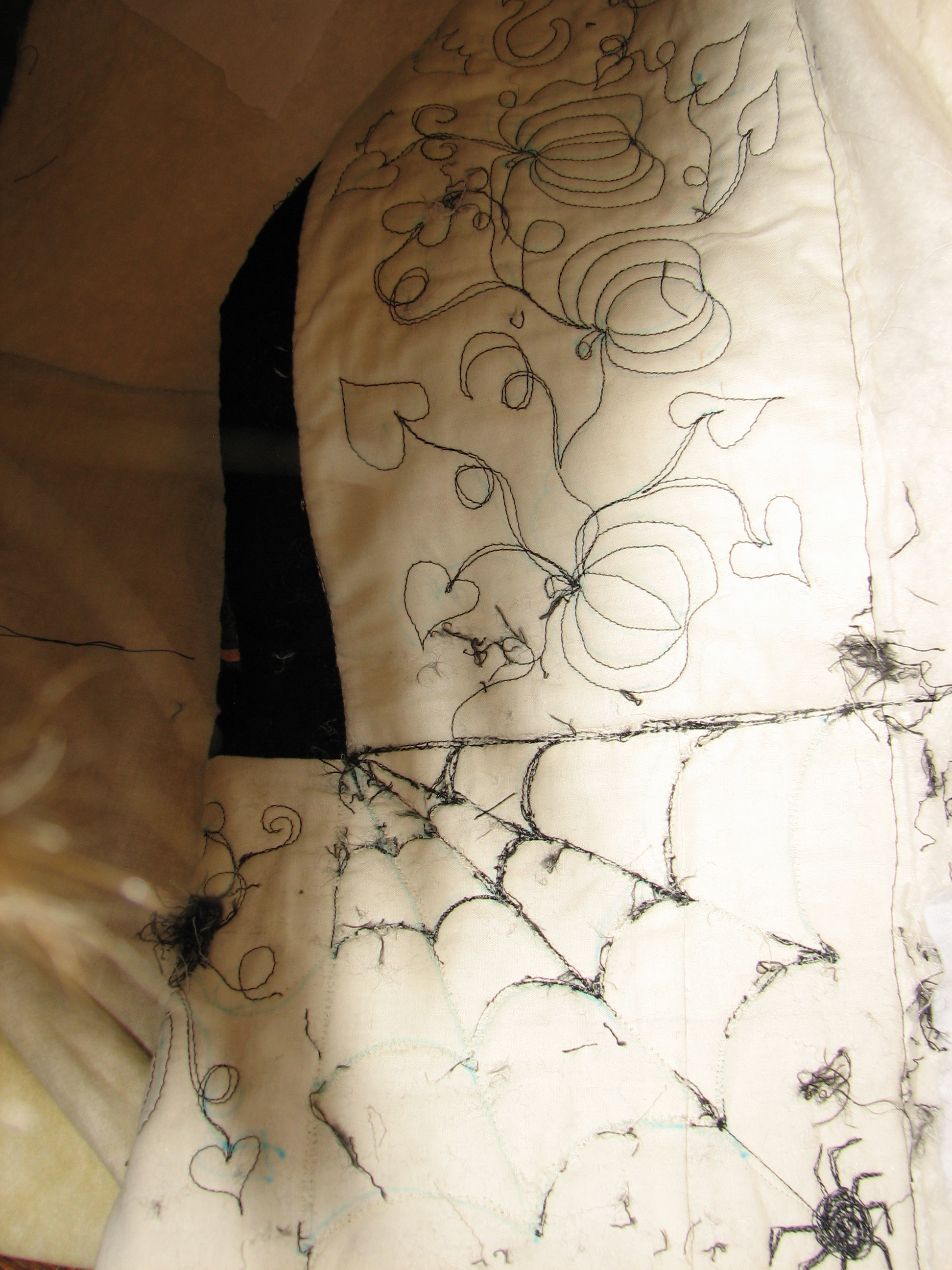
The stitching in the outside border is of cats on a fence, jack-o-lanterns, bats and pumpkins.  I used my new micro handles to help me stitch those.  I stitched spider webs and a spider into the corners.  The problem is that I wasn’t satisfied with how perfect the stitches were (or were not), so I did some thread painting to smooth the rough edges.  Thread painting is basically sketching with thread.  Of course, after I was finished I was mortified.  I thread paint on my own quilts all the time, but how could I do that to a customer’s quilt?  I had to rip it out and put a simple one-line stitching for that spider web.

So, here is the dastardly deed in progress…Image

Notice the “weapons” on the right side of the picture that were used in tackling this project.  I had been working for 3+ hours on just this one corner.  You have to be very careful pulling out those stitches because you don’t want to rip the fabric or pull any of the threads of the fabric in the process.

Here is what the stitching should look like with only one layer of stitching and no thread painting.  This is the border next to that corner – white/cream fabric with black stitching.

Image

And, here is what the other 3 corners look like before “frogging.”

Image

It actually doesn’t look that bad (now that I’m 3+ hours into the task every quilter dreads and looking at several more hours of this… and multiply that by 3 more corners, each taking a day to rip out).  And, the extra stitching actually helps to stabilize the corner stones. Soooo… I have decided that I will leave the other 3 spider webs as they are.  I will continue frogging this particular spider web and will re-stitch it to look like it did and/or the other 3 webs.  If the customer is not happy with it (and I’m very much okay with that!) then I will certainly frog all 4 corners.  At this point, though, I just want to get this quilt to the owners.

Lesson learned!  And, I’ve also learned that I am going to try quilting with the same thread on top and in the bobbin.  Most people do that, but I have been trying to match the bobbin thread with the backing fabric (in this case it is a mottled tan/cream).  The cream colored and orange variegated top threads worked fine with the cream colored bobbin thread. But, for whatever reason, that black thread did not cooperate at all, so it shows through on the back anyhow – drives me nuts.  I worked and worked with it to no avail.  I can certainly see now why others use the same color on top and bottom.

She’s “cute as a button” at MQS

It’s been a couple of weeks since I’ve been at Machine Quilters Showcase (MQS) and figured I’d better get something posted before I forget.  I have been attending and volunteering at MQS for the last 3 years and have loved every minute of each show.  I am sad that it will be moving to Wichita, Kansas next year but it’s only about 3 1/2 hours away so I really shouldn’t be too sad.  I just won’t be able to volunteer like I have in the past.

MQS, along with the other big quilt shows, is a chance to take classes from big name quilters as well as the lesser known, but equally talented, quilters.  It’s also a chance to meet friends you have made online such as through Facebook.  For whatever reason, I did not take many pictures at all this year.  I had my camera with me all the time, but only managed to take pictures of the first class I took.  That was with Sue Patten.  She has a lot of energy and is a fabulous teacher as well as a very creative stitcher.  She has variegated threads figured out to a science ~ WAAAY over my head, but I took her class anyway.  I don’t think I will EVER have her talent and knack for figuring out how to get variegated threads to do what I want on both the front and the back of the quilt, but yesterday I did manage to put certain colors of the variegated thread I was using in particular places on the quilt I was working on.  Here’s a shot of Sue with one of her quilts.

Image

I also managed to meet a couple of friends I’d only chatted with online.  Here is Kelly Hanson and me.  Image

Isn’t she cute as a button?